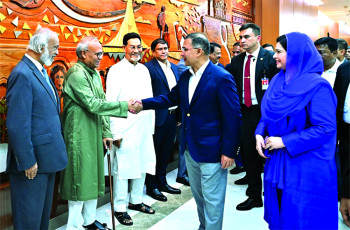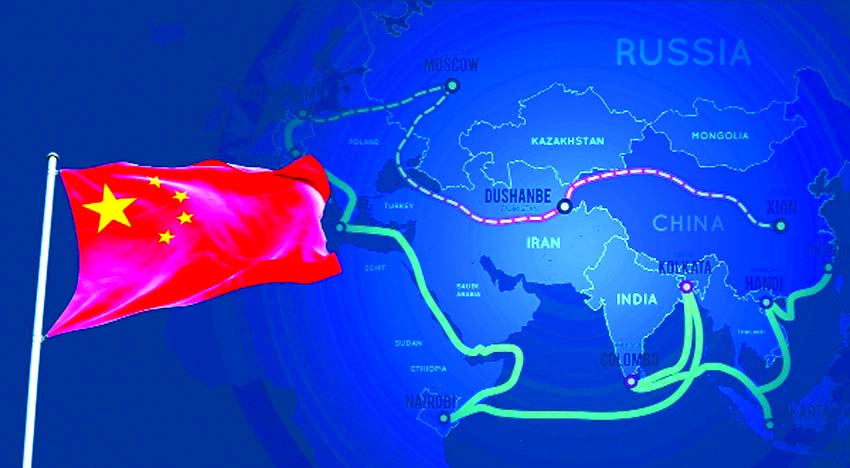
On 14 October 2016, during the historic visit of Chinese President Xi Jinping to Bangladesh, Dhaka and Beijing officially upgraded their relationship to a Strategic Partnership of Cooperation and Bangladesh became a participant in the Chinese-financed Belt and Road Initiative (BRI). Since then, several Chinese-sponsored major infrastructure projects have been completed in Bangladesh and several more are underway.
On 11 July 2024, Dhaka and Beijing further elevated their partnership to the level of Comprehensive Strategic Cooperative Partnership. Even the subsequent political upheavals in Bangladesh - including the July Uprising that removed the Hasina government less than a month later, the formation of the interim government, and the victory of Bangladesh Nationalist Party (BNP) in 2026 general elections - have not hindered Bangladesh's continued participation in BRI.
Since 2016, Bangladesh's involvement in BRI has been widely discussed and dissected. Depending on their political orientation, some have championed Bangladesh's growing partnership with China and commended infrastructure development through BRI, while some others have voiced concerns about possible fallout in relations with India and the United States and a potential "debt trap." However, the reality is far more nuanced than the simplified polemics presented by many commentators.
Under BRI programs, Bangladesh was supposed to receive approximately $40 billion in investments from China: $26 billion for independent projects and $14 billion for joint venture projects. However, most of these investments are yet to be materialized. Chinese Ambassador to Bangladesh Yao Wen stated in 2023 that China had disbursed $4.45 billion - just over one-tenth of the promised amount - for 35 BRI projects in the country. However, the exact amount disbursed by China to Bangladesh under the BRI between October 2016 and April 2026 is not known.
Most of the BRI projects in Bangladesh are related to transport and energy infrastructure, but there are difficulties in determining the exact number of BRI projects in the country based on publicly available data. Most estimates mention 35-40 projects, with one website listing as many as 64 projects under the BRI, albeit mistakenly. Hence, the unavailability of exact data about the BRI in Bangladesh is a major hindrance to examining its real effects--that said, based on the available data, getting a general picture is still possible.
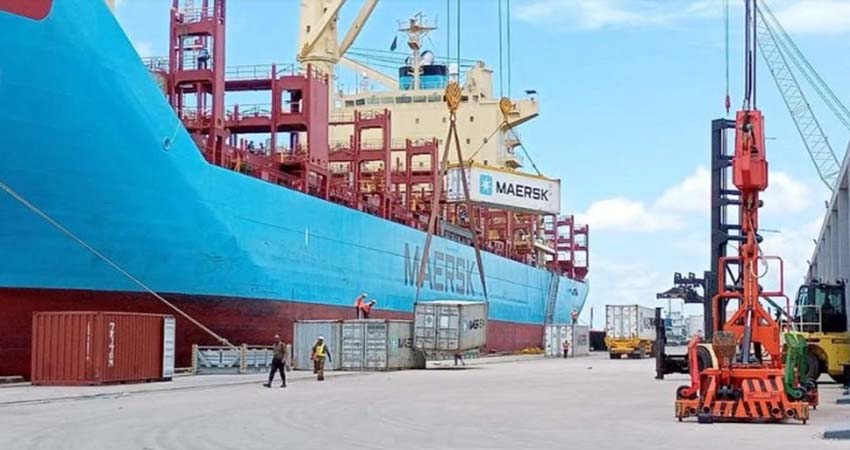
So far, the completed BRI projects in Bangladesh include the Padma Multipurpose Bridge, the Eighth Bangladesh-China Friendship Bridge, the Padma Bridge Rail Link, the Chattogram-Cox's Bazar Rail Line, the Chattogram Elevated Expressway, the Karnaphuli Tunnel, the Payra Thermal Power Plant, the Banshkhali Coal-fired Power Plant, the Dasherkandi Sewage Treatment Plant, the IV Tier National Data Center, and the Bangladesh-China Friendship Exhibition Center. Partially completed, under-construction, and proposed BRI projects in the country include the Payra Seaport, the Ninth Bangladesh-China Friendship Bridge, the Dhaka Elevated Expressway, the Dhaka-Ashulia Elevated Expressway, the expansion of the Mongla Port, the Maheshkhali Single Point Mooring Project, the development of power supply line under the Power Grid Bangladesh PLC, the development of power supply system under the Dhaka Power Distribution Company (DPDC) the Chinese Economic and Industrial Zone in Chattogram.
SM/CitizenTimes